
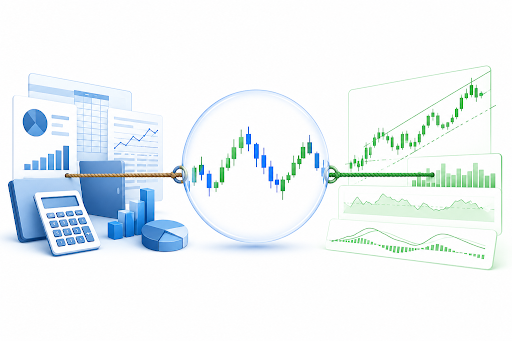

Every trader eventually encounters a frustrating situation.
The fundamentals suggest a stock is wildly overvalued, yet it keeps climbing. Or the company looks incredibly attractive on paper, but the chart continues to fall.
So which should you trust?
For active traders, the answer is often simpler than people expect: price action comes first. Fundamentals provide valuable context, but they should rarely override what the market is actually doing.
Fundamentals and Technicals Measure Different Things
Fundamental analysis attempts to determine what a company is worth based on its business, earnings, growth prospects, and financial performance. The assumption is that, eventually, the stock price will reflect that value.
Technical analysis focuses on something entirely different. It measures how market participants are behaving right now by analyzing price, volume, momentum, and trend.
Neither approach is inherently wrong—they simply answer different questions.
Fundamentals ask, “What should this company be worth?”
Technicals ask, “What is the market doing today?”
For traders operating on short timeframes, that distinction matters.
Why Fundamentals Can Hurt Active Traders
Fundamentals aren’t useless, but they often create problems when traders rely on them too heavily.
One issue is that most traders don’t have a true edge in fundamental analysis. They’re competing against professional analysts who spend years studying individual industries, building financial models, and speaking with management teams. Reading a few financial ratios or social media opinions rarely provides the same level of insight.
More importantly, strong fundamental opinions can create dangerous bias.
A trader convinced that a stock is “obviously overvalued” may continue holding a losing short position while the stock rallies another 30%, 50%, or even 100%. Instead of respecting the market, they begin rationalizing the loss by telling themselves they’re simply early.
Unfortunately, trading rewards good timing and disciplined risk management—not being eventually right.
Timeframe Matters
One of the biggest mistakes traders make is confusing an investment thesis with a trading thesis.
Fundamental value often takes months or years to play out. Trading decisions, however, happen over days, hours, or even minutes.
A company can be dramatically overvalued and still continue rising for weeks because of momentum, positioning, or investor sentiment. Likewise, an undervalued stock can remain depressed far longer than expected.
Markets don’t move on valuation alone, especially in the short term. (Learn about Multi-Timeframe Analysis HERE)
Markets Can Stay Irrational Longer Than You Expect
MicroStrategy became a perfect example of this principle.
For extended periods, the company traded well above the value of its Bitcoin holdings. Many traders believed the premium had to disappear and positioned themselves accordingly.
Eventually, the valuation did normalize.
The problem was timing.
Before that happened, bullish sentiment pushed the stock even higher, forcing many traders out of their positions long before fundamentals finally mattered.
The lesson isn’t that valuation is meaningless. It’s that price can remain disconnected from fair value much longer than most traders expect.
Never Let Fundamentals Override the Chart
The biggest danger of strong fundamental opinions is that they encourage traders to ignore what the chart is telling them.
They refuse to exit losing positions because the stock is “too cheap.”
They continue averaging down because the valuation “doesn’t make sense.”
They miss high-quality long setups because they dislike the company.
Over time, fundamentals stop providing context and begin creating emotional attachment.
For active traders, the chart offers the most important feedback available. It reflects what buyers and sellers are actually doing—not what they should be doing.
A simple rule can prevent many costly mistakes:
The chart is always right.
That doesn’t mean the market is perfectly efficient. It simply means traders should respect price action before personal opinions.
When Fundamentals Become Valuable
Although fundamentals shouldn’t dominate trading decisions, they still play an important role.
They’re especially useful for understanding catalysts.
Earnings reports, product launches, regulatory approvals, acquisitions, or major business developments all help explain why a stock is moving and whether that move could continue.
Fundamentals also help identify who is participating in the trade. Knowing what institutional investors care about—whether it’s subscriber growth, margins, or guidance—can provide valuable insight into how they may react to new information.
Most importantly, fundamentals become especially powerful when they align with technicals.
The Best Trades Combine Both
Some of the highest-conviction opportunities occur when strong fundamentals and strong technicals point in the same direction.
If a company delivers a meaningful catalyst and the stock confirms it with a breakout on heavy volume, both fundamental and technical traders often begin buying simultaneously.
That alignment creates powerful momentum and increases the probability of sustained price movement.
Rather than fighting the market, you’re trading alongside it.
Final Thoughts
For most active traders, fundamentals should provide context—not conviction. (You also need to reference your Trading Playbook)
Use them to understand the story behind a stock, evaluate important catalysts, and recognize how other market participants may react.
But when it’s time to make a trading decision, let price action lead.
The market doesn’t care what you believe a stock should be worth today. It only reflects what buyers and sellers are willing to pay right now.
Respect the trend, follow the chart, manage your risk, and let fundamentals support your analysis—not replace it.
