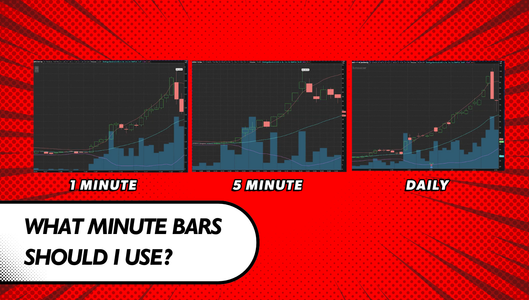

Ah yes… the age-old question: what timeframe is best?
People often ask me why I use 2-minute bars on my intraday chart — and what type of voodoo magic makes 2-minute bars work so well.
In this video, I’m going to exclusively reveal the exact voodoo magic involved — a result of the ancient curse enacted during the Trader Wizard Battle of 1854!
Just kidding.
The real, illustrious answer for why I use 2-minute bars?
Because my trainer used them.
Literally that simple.
Why 2-Minute Bars?
During the majority of my day-trading career, 2-minute bars offered the right level of granularity.
They allowed me to catch the type of intraday moves I wanted to trade — and over time, they simply became what I was used to.
It wouldn’t make sense to be a day trader using monthly bars, right?
At the same time, I found 1-minute bars (or tick charts) a little too myopic when I wanted to catch the intraday legs.
A Little Comic Relief
There were multiple times on the trading floor when either I — or one of my trainees — would accidentally be on the wrong time frame.
Maybe they’d be on a 1-minute or 5-minute chart without realizing it.
You’d hear someone go,
“Uhh… why does your chart look different than mine?”
Then it would click.
“Oh hey dummy, you’re not on 2-minute bars.”
We’d all laugh, mock that person for ignoring the “voodoo magic,” and claim they’d missed out on all the free 2-minute bar money.
And yes — when I tell these jokes to the camera, I imagine you all laughing hysterically at home… not the total silence I usually get.
If you don’t find these jokes funny — please don’t tell me. Don’t ruin my bliss.
Finding Your Timeframe
For traders, timeframe selection is deeply personal — intertwined with your trading style, goals, and even your personality.
My preference for 2-minute bars stems from being an intraday trader, balancing the right amount of market noise versus signal.
But it’s important to understand: timeframes are not one-size-fits-all.
The Fractal Nature of the Market
In my lesson on fractals, I discuss how patterns and concepts in trading are not confined to a specific timeframe.
Whether it’s 1-minute, 5-minute, or daily bars, the patterns hold true across different scales.


The real skill lies in identifying which timeframe resonates with your trading style.
This isn’t just about comfort — it’s about synchronizing with the market’s rhythm in a way that matches your analysis style, reaction speed, and risk tolerance.
Short vs. Long Timeframes
Shorter timeframes tend to suit those who:
- Thrive on rapid decision-making
- Can manage fast-paced stress
- Want to exploit small, frequent inefficiencies
Conversely, longer timeframes tend to appeal to those who:
- Prefer deeper analysis
- Want a calmer, more deliberate pace
- Balance trading with other responsibilities
If you have a part-time or full-time job, higher timeframes will always be more conducive than trying to watch every tick of the chart.
Where the Edge Lives
I have a theory:
For traders (not investors), the most edge often exists in the shortest timeframes.
But there’s a tradeoff — the shorter the timeframe, the more:
- You must be glued to your screen
- You’re impacted by liquidity constraints
- You rely on precision and mental stamina
While swing or bigger-picture trading might not have as many extreme, short-term opportunities, the benefit is scalability — and a wider time window for analysis and decision-making. Learn more about Types of Trading Edge HERE.
Evolving With Your Trading Life
For much of my career, I was glued to my desk every minute of the trading day.
Catching intraday legs right in front of me made perfect sense.
Nowadays, as I spend less time tied to the screens, I find myself favoring swing trades and daily time horizons far more often.
That’s the beauty of trading — your timeframe can (and should) evolve with your lifestyle and focus.
Final Thoughts
Ultimately, successful trading is about adapting your strategy to your personality and circumstances.
By experimenting with different timeframes and observing how market patterns unfold across them, you’ll begin to tailor your approach — maximizing your strengths and aligning with your personal trading philosophy.
There’s no voodoo magic in picking a timeframe.
Just self-awareness, practice, and alignment with how you see the market.
