

If there’s one concept that should sit at the heart of every trade you take, it’s this:
Expected value is always changing.
And if you’re serious about trading, it’s your job to constantly reassess it — in real time — and adjust your decisions accordingly.
Once you truly internalize this concept, it becomes much easier to understand one of the most advanced and nuanced techniques in active trading:
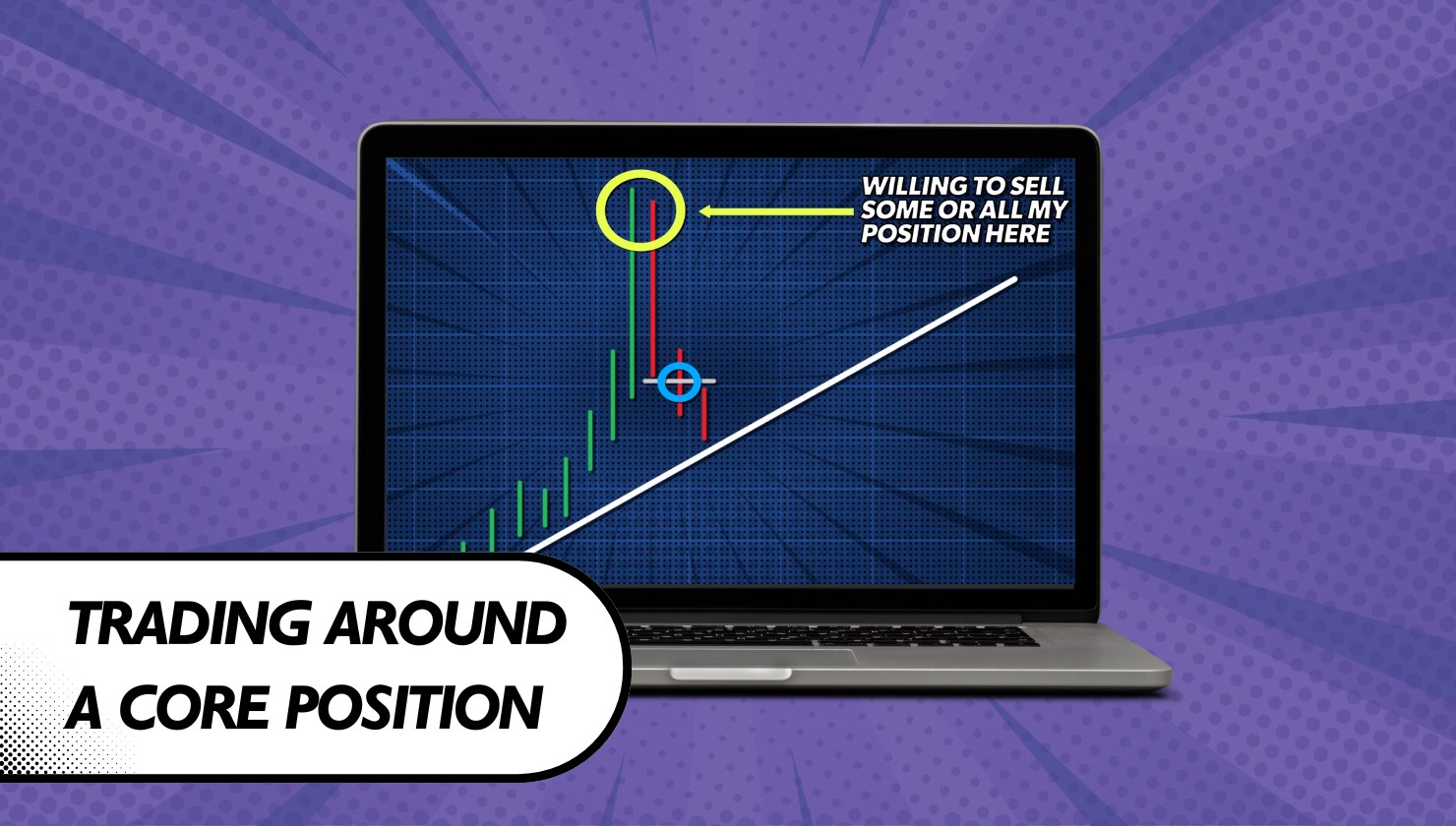
Trading around a core position.
This idea inevitably comes up when people ask questions like:
- “Do you always hold your full size until your stop hits?”
- “Do you ever scalp around your positions?”
- “When do you take partial profits or add to your position?”
Let’s break this down through the lens of dynamic expected value (EV), because that’s what drives all these decisions.
Why Trading Isn’t Poker (And Why That’s a Good Thing)
In poker, once your chips are in the pot, that’s it — you’re locked in. If a bad river card comes, tough luck. You don’t get to pull some chips out mid-hand.
But in trading? You can trim, add, close, or completely flip your position in an instant.
That flexibility is a massive edge — but only if you know how to wield it properly. And that’s where expected value becomes your compass. Not rigid rules. Not arbitrary stop distances. Just intelligent, evolving risk assessment.
(What you really want to trade is a Broke Slot Machine – learn more about that here!)
The Core Idea: Let EV Dictate Everything
Here’s how this plays out in practice:
You might enter a trade with a clean setup — maybe you’re long, expecting a breakout. Initially, the expected value looks solid. Your stop is set at a logical level (say, the prior bar low), and your target has a strong reward-to-risk ratio.
But what if something changes? What if the price action suddenly accelerates in a way that looks unsustainable? What if volume dries up? Or a negative headline crosses the wire?
If the EV drops significantly, you don’t just sit there and hope.
You reduce size. Maybe you even exit the position entirely.
Conversely, let’s say the opposite happens — a strong buyer steps in, or a new catalyst appears mid-trade. Maybe the pattern evolves into something even stronger than your initial thesis.
If the EV improves, that’s your signal to add size, assuming your risk remains controlled and the reward still outweighs it.
Every decision you make should stem from this principle.
A Real-World Example: Scaling Into Strength
Picture a stock holding a clean downtrend. You notice a capitulatory flush followed by a reversal through prior bar highs. That initial break might trigger your entry.
But the trade doesn’t stop there.
- If the downtrend breaks,
- if the volume profile shifts,
- if market context supports continuation…
That’s a green light to press the trade and build around your core position. You’re not “averaging in” blindly — you’re scaling up as the opportunity becomes stronger.
The Pendulum Framework: Trading Extremes with Precision
This is where the pendulum concept becomes incredibly useful.
Markets rarely move in a straight line. They swing — often violently — from one extreme to another. And the more they stretch beyond equilibrium, the more likely they are to revert.
So when price pushes to a bearish extreme, and sentiment is max fear, you may look to:
- Cover shorts into weakness
- Add to a long position if a reversal setup appears
Likewise, at a bullish extreme, when price is euphoric and chasing, you might:
- Trim or exit long exposure
- Start building into a short thesis
This is where trading around a core position shines. You’re not forcing full-size entries or exits. You’re adapting — reading context, stretching your risk when conditions are ideal, and pulling back when they’re not.
Mean Reversion and Knowing When to Exit Early
Let’s say you’re in a mean-reversion setup and the stock has already retraced 80–90% of the prior move. Do you really need to hang on for that final 10%?
Probably not.
Often, the expected value deteriorates as the trade gets crowded or loses momentum. Even if your original target was 100%, discretion and EV-based thinking might tell you to step aside early. Don’t be greedy. Protect the edge.
Putting It All Together: The Only Framework That Matters
Let’s simplify the hierarchy:
- Risk management comes first.
This protects your downside and ensures survival. - Expected value drives every other decision.
It tells you when to:- Add to a trade
- Trim a position
- Exit entirely
- Sit tight and let it ride
- Add to a trade
No fixed rule — not even your initial stop or target — overrides your ongoing assessment of risk and reward. Trading is not about being rigid; it’s about adjusting with intention.
A Mental Model to Adopt: Capital Allocation as EV Betting
Every trading decision is an allocation of capital. And the best traders allocate it where the odds are best over the long run.
That’s why rules like “always let your winners run” or “never scale in” only work in textbooks. Real markets demand dynamic thinking.
You’re not trading a chart.
You’re trading evolving probabilities.
The more fluidly you adjust size, risk, and exposure around your core — based on changing conditions — the more consistent and scalable your results become.
Final Thought
Trading around a core position is not about being fancy or overcomplicating things. It’s about respecting how fast markets change — and building a system that adapts with them.
So don’t ask whether you “should” trim or add.
Ask this instead:
“Given what I see right now, where is the expected value best?”
That question, answered again and again, is what separates professionals from hopefuls.
