


Why Traders Mismanage Positions When They Anchor to the Wrong Variable
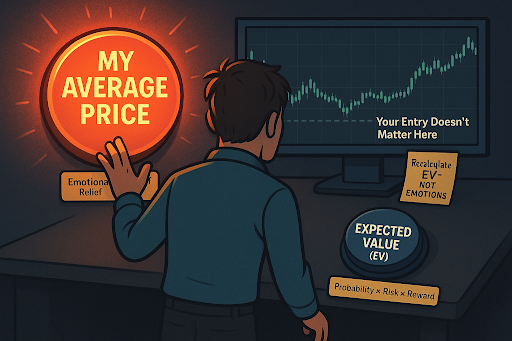
One of the most important corollaries in the broader discussion around Expected Value is a concept that trips up traders at every level: your average price in a trade is irrelevant to the Expected Value.
Not partially irrelevant.
Not sometimes irrelevant.
100% irrelevant.
And the reason this matters so much is simple: traders — both new and experienced — let their average price dictate decisions that should be driven purely by Expected Value. This is one of the most common sources of avoidable PnL leaks in the trading world.
Why Average Price Creates False Confidence (and False Panic)
You’ve probably heard statements like:
- “I’m going to hold onto a core big-picture because my average price is so good.”
- Or you’ve seen someone hold a position way out of the money, let it turn, and then sell right as it approaches their average price — out of pure emotional relief.
Both are classic examples of traders making decisions based on something that has zero mathematical relationship to the current Expected Value.
And to be fair, both are symptoms of the same problem:
They are anchoring to average price instead of recalculating EV at that moment in time.
Where Average Price Fits Into Expected Value (Spoiler: It Doesn’t)
When we revisit the Expected Value equation:
EV = (Reward × Probability) – (Risk × Probability)
…the first thing worth noticing is what’s missing:
- Not your PnL.
- Not your emotions.
- And certainly not your average price.
Expected Value at any moment is agnostic to whether you are long, short, flat, or not even watching the stock. (It’s actually ALWAYS CHANGING)
It is simply a mathematical snapshot of risk, reward, and probabilities at that moment, completely independent of your personal position.
Real Example: Why Misunderstanding EV Leads to Bad Decisions
Take the intraday chart of TSLA on 7/8/24.
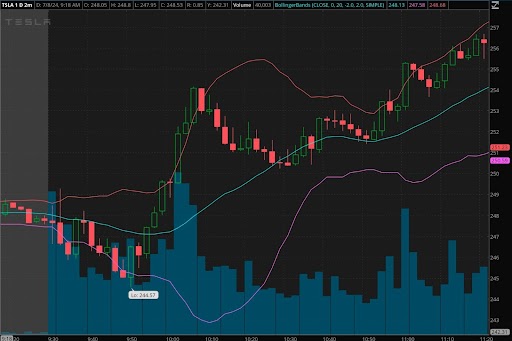
Two common trader mistakes show up here:
Mistake 1: Shorting at $253, going out of the money, then covering at breakeven
The trader ignores that the Expected Value finally went positive right when it came back near their average price.
Instead of recognizing a favorable EV moment, they react emotionally and flatten the position simply because breakeven “feels good.”
Mistake 2: Getting a great short entry… then using that to justify holding big-picture
This trader anchors to the idea of having an amazing entry.
So instead of covering when Expected Value becomes marginal or negative, they hold — and bleed away the gains the trade initially offered.
Both traders mismanage the same thing:
the market is agnostic to their position, and they should be too.
The Market Doesn’t Care About Your Position. Neither Should You.
The only correct way to manage a trade is through the lens of Expected Value.
Your job is to:
- Constantly reassess reward and risk
- Continuously update probabilities
- Ignore emotional biases tied to your position
- And make decisions the market deserves — not the decisions that “feel good” based on your entry
This is what elite traders do differently. (Learn more about Elite Traders HERE)
Internalizing This Concept Takes Time — But Saves Money Forever
Many traders struggle with this because average price feels tangible.
It’s easy to get attached to it.
It gives a sense of control.
But it’s a trap.
And one of the biggest long-term PnL leaks comes from clinging to average price instead of evaluating trades with the only variable that actually matters: Expected Value.
If you consistently reverse-engineer your trades and ask:
- Was I reacting to EV or reacting to my average price?
- Did I justify staying in a trade just because my entry “felt good”?
- Did I exit a trade just because it came back to breakeven?
…you’ll quickly see how often this mistake shows up.
Fixing it is one of the fastest ways to stop bleeding PnL and start thinking like a professional.
