
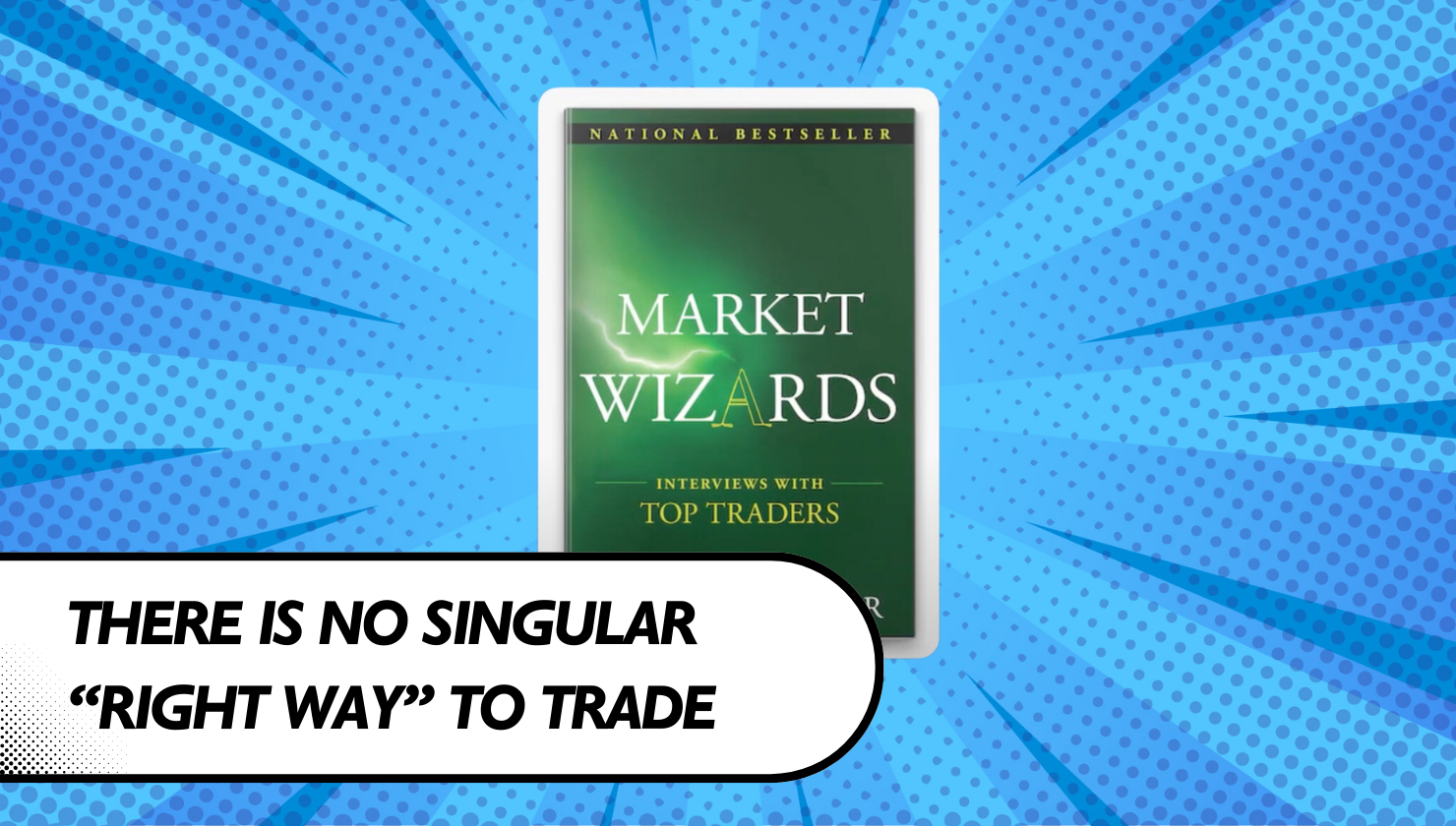

My journey into the world of trading was ignited by the Market Wizards book series by Jack D. Schwager. What captivated me was the realization that there were many different ways to beat the markets.
Reading Market Wizards exposed me to traders who approached the markets from completely different angles. Some relied on advanced statistics and programming. Others leaned on psychology, experience, and raw intuition. Yet despite these wildly different approaches, many of them were consistently able to outperform the market.
That was a powerful realization.
The beauty of trading lies in the fact that success can be achieved through diverse strategies, skill sets, and perspectives. This is why the trading world includes quants, discretionary traders, programmers, arbitrageurs, and many others — all finding their own unique path to success.
Trading Is Not One-Size-Fits-All
Over the course of my trading career, I learned an important lesson: there is no singular “right” way to trade.
What works for me may not be the ideal approach for someone else. The key point to understand is that there isn’t a fixed number of ways to succeed in trading. Instead, success comes from discovering the methods that best align with your own strengths, thinking style, and decision-making process.
I’ve proven that success can be achieved using my particular methodology, and I’ve had the privilege of teaching dozens of others to follow this path successfully as well. This is important because it demonstrates that the approach I teach is not just theoretical — it can be learned, applied, and mastered by others.
However, that doesn’t invalidate other strategies or perspectives.
Different Traders, Different Edges
Many people tend to oversimplify trading discussions into black-and-white thinking. If someone disagrees about a tool, indicator, or methodology, they assume one person must be right and the other must be wrong.
In reality, disagreements in trading often reflect differences in style rather than correctness.
If I dismiss an indicator as useless, it simply means it is useless for me and lacks relevance to my approach. Likewise, if another trader argues that something I consider essential is irrelevant to them, that usually reflects the uniqueness of their own trading framework.
Both can be correct within their own systems.
Find What Works for You
My experience — reinforced by the lessons from the Market Wizards series — highlights an essential truth about trading: it is not a one-size-fits-all pursuit.
The goal isn’t to limit your perspective or blindly copy someone else’s method. The goal is to discover your edge and build a strategy that aligns with your strengths, preferences, and way of thinking.
So approach what I teach with an open mind. Take the time to deeply understand the ideas and concepts. But ultimately, make your own decisions about what resonates most with you and your trading.
Because the traders who succeed long term aren’t the ones who copy a strategy.
They’re the ones who develop a system that truly fits them.
