
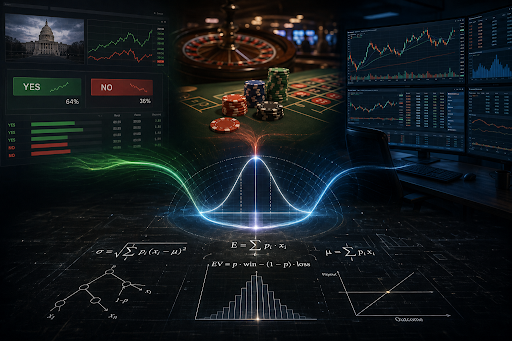

Sports betting, prediction markets, and stock trading may look completely different on the surface, but underneath, they share one important concept: probability.
Every time you place a trade or make a bet, you’re effectively taking a position on an uncertain outcome. The question isn’t simply whether you think you’re right. It’s whether the odds being offered give you a positive expected value.
That distinction is what separates disciplined decision-making from gambling.
Trading, Gambling, and Prediction Markets Aren’t the Same Game
Stock trading differs from sports betting and prediction markets in an important way.
Investing in stocks can be part of a positive-sum system. Companies create products, generate profits, grow, and contribute to the broader economy. Investors can benefit from that growth.
Sports betting and prediction markets are different. After commissions, spreads, and fees, participants collectively lose money while the operators and platforms collect revenue.
That doesn’t mean every individual participant loses. A skilled participant can potentially find an edge. But without one, the math is working against you.
And as prediction markets continue expanding, people can increasingly place bets on almost anything. The easier it becomes to turn opinions into wagers, the more important it becomes to understand the underlying math.
Expected Value Is the Foundation
Whether you’re trading Apple, betting on a football game, or buying a prediction-market contract, the fundamental question is the same:
Do you have positive expected value? (Read more about Expected Value HERE)
In simple terms, you’re looking for situations where the probability of an outcome occurring is different enough from the probability the market is pricing in to justify taking the risk.
If you can’t explain why your probability estimate is better than the market’s, you’re essentially making a guess.
And if you’re consistently making guesses in markets where professionals are competing against you, the long-term math is unlikely to be favorable.
You Need a Real Edge
The problem is that these markets are generally quite efficient.
In sports betting, for example, most casual bettors rely on intuition. They watch games, follow teams, notice streaks, and believe they understand where the market is wrong.
But very few are actually conducting serious quantitative research.
A profitable sports bettor might spend hundreds of hours developing and backtesting a model designed to exploit specific behavioral patterns. Even then, the edge can be incredibly thin after accounting for spreads and commissions.
The same principle applies to trading and prediction markets.
If you’re competing against sophisticated participants without having a clearly defined advantage, you’re starting from behind.
Breaking News Can Create an Edge
One potential source of opportunity across all three markets is speed.
In stocks, an earnings report, tariff announcement, or major corporate development can cause a sudden repricing.
The same thing happens in sports betting when a star player gets injured, or in prediction markets when unexpected political or economic news changes the probability of an event.
The opportunity exists because markets need to adjust to new information.
But you’re not the only one looking for these opportunities. Algorithms are constantly scanning for new information and attempting to capture mispricings before slower participants can react.
The mechanics are remarkably similar: new information arrives, probabilities change, and participants race to adjust their positions.
Your Edge Doesn’t Automatically Transfer
One of the biggest mistakes traders make is assuming that success in one market automatically gives them an advantage in another.
A trader might be highly skilled at technical analysis and then assume that skill will translate directly to sports betting or prediction markets.
It doesn’t necessarily work that way.
If technical analysis is your primary edge in stocks, moving into a market where that edge doesn’t apply means you’re entering a new game without your strongest tool.
Being good at trading doesn’t automatically make you good at predicting elections, sporting events, or other outcomes.
Information Advantages Can Change the Game
Prediction markets have another important difference: information asymmetry can be significant.
There have been cases where participants with highly specific information have positioned themselves before major events, creating enormous advantages over ordinary market participants.
This creates a dangerous illusion. A prediction market may look simple because the contract itself is easy to understand, but simplicity doesn’t mean the market is easy to beat.
In fact, the simpler the product appears, the easier it can be for sophisticated participants to identify and exploit inexperienced traders.
Sports Betting Has Another Disadvantage
Sports betting also has a structural problem that doesn’t exist in the same way in traditional stock trading.
Betting platforms have an incentive to protect themselves against highly successful bettors. Sophisticated players can face restrictions on how much they’re allowed to wager, making it difficult to scale a profitable strategy.
A stock brokerage, by contrast, generally benefits when you trade successfully and grow your account.
The incentives aren’t necessarily aligned in the same way with a sportsbook.
Sometimes the Best Trade Is No Trade
If you participate in any of these markets, establish some basic rules.
If you can’t clearly explain your edge, you probably don’t have one.
If you can’t estimate your expected value, you’re guessing.
And if you realize you’re playing a game where the odds are heavily stacked against you, walking away is always an option.
In fact, for many people, walking away may be the highest-expected-value decision available.
Final Thoughts
The biggest edge isn’t always a strategy, indicator, or sophisticated model.
Sometimes it’s simply knowing which games to play and which games to avoid.
Trading, sports betting, and prediction markets all involve probabilities, but that doesn’t mean they’re equally attractive opportunities. Before risking your money, understand the math, identify your edge, and recognize who you’re competing against.
If you can’t find a genuine advantage, there’s no shame in sitting out.
In many markets, the most profitable decision you can make is knowing when not to play.
Next read: “What is edge in trading?”
