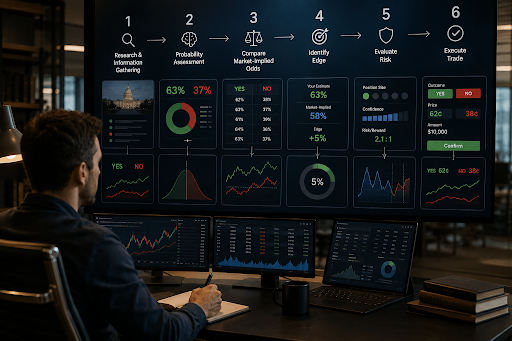

Prediction markets may look simple. You choose an outcome, buy a contract, and wait to see what happens.
But simplicity can be deceptive.
If you approach prediction markets like a gambler, you’ll likely get the same result as a gambler: losses. The better way to think about these markets is as a form of trading, where the goal is to identify probabilities that are mispriced and manage risk accordingly.
Here’s the framework I would use.
1. Understand What a Prediction Market Actually Is
Prediction markets are essentially binary markets built around the outcome of an event.
A contract might ask whether a candidate will win an election, whether it will rain on a particular day, or whether a certain statement will be made at a press conference.
The contract is then priced according to the market’s perceived probability of that outcome.
For example, if a contract trades at $0.65, the market is effectively saying there’s approximately a 65% chance the event will happen.
That means your job isn’t simply to decide whether the event will happen.
Your question should be:
Is the market’s probability wrong?
If you don’t believe the probability is mispriced enough to overcome fees, spreads, and other risks, there’s no reason to take the trade.
2. Edge Is Non-Negotiable
Just like in stock trading, you need an identifiable edge.
That edge can come from several places.
Information Asymmetry
Some participants may have information or insights that others don’t. This can include situations involving people with direct access to information, although relying on potentially illegal insider information is obviously not an appropriate trading strategy.
Speed
Markets can reprice rapidly when new information appears. Traders or algorithms that interpret and react to information faster than others can potentially capture that move.
Structural or Behavioral Inefficiencies
Human beings aren’t perfectly rational.
People can become overly emotional, influenced by narratives, or biased toward certain outcomes. Those behavioral tendencies can create mispriced probabilities.
Arbitrage
Sometimes prediction markets can price an event differently from related markets in stocks, futures, or crypto.
There can also be opportunities when an outcome is essentially determined but the contract won’t formally resolve for some time. The capital being tied up during that period can affect what someone is willing to pay for the contract.
The important point is simple: if you can’t explain where your edge comes from, you probably don’t have one.
3. Look for Repricing After Breaking News
Prediction markets become especially interesting when unexpected information hits.
A court decision, health announcement, corporate development, or political headline can immediately change the probability of an outcome.
If you’re faster or better at interpreting the information than the market, there may be an opportunity.
This is similar to trading stocks around breaking news. The initial headline may be obvious, but understanding its second-order effects can be much harder.
Some developments are complicated enough that it takes time for participants to understand what they actually mean. That’s one area where experienced discretionary traders may still have an advantage over purely automated systems.
4. Understand Behavioral Biases
Prediction markets are particularly vulnerable to human psychology because participants are literally assigning probabilities to uncertain outcomes.
Several common biases can distort those probabilities.
Recency Bias
People tend to overweight what happened most recently.
A team that performed poorly yesterday might suddenly be viewed as much worse than it actually is, even though its underlying situation hasn’t materially changed.
Narrative Bias
People are heavily influenced by the stories they see repeated around them.
Negative news, conflict, and dramatic events tend to attract more attention than boring but important realities. When the prevailing narrative becomes disconnected from reality, that disconnect can create opportunity.
Overconfidence
Markets can become excessively confident in outcomes, pushing probabilities toward 95%, 99%, or even higher.
But real-world systems are often messy and unpredictable.
Legal decisions are a good example. An outcome may appear nearly certain until a court ruling completely changes the situation. Anyone who has traded a merger knows the same principle: nothing is truly finished until it’s finished.
5. Risk Management Comes First
Prediction markets can create a false sense of security because your maximum loss on a contract is generally defined.
But defined downside doesn’t mean unlimited position sizing is safe.
The leaderboards also create another psychological trap. You see a handful of traders making enormous returns and naturally become envious or greedy, without seeing all the losing trades happening underneath those headline results.
The solution is the same as in traditional trading: establish risk limits.
Don’t let confidence convince you that you can’t be wrong. You can miss an important detail in a contract, misunderstand an event, or simply misjudge the probability.
You need guardrails before you need them.
6. Recognize That These Markets Aren’t for Everyone
This may be the most important part of the framework.
Prediction markets are not an easy-money machine.
The increasing ability to bet on almost anything can encourage the same behaviors associated with gambling: emotional decision-making, constant speculation, and chasing short-term excitement.
That doesn’t mean every participant is gambling or that every prediction market is inherently bad. But the accessibility of these markets can make it particularly easy for vulnerable people to turn speculation into a habit.
As prediction markets expand, traders need to be honest about whether they’re actually identifying an edge or simply looking for another way to bet.
Final Thoughts
Prediction markets may look different from traditional stock markets, but many of the same principles apply.
You need an edge. You need to understand what is driving the market. You need to recognize behavioral biases. And above all, you need disciplined risk management.
Don’t enter a prediction market simply because you have an opinion about what will happen.
Instead, ask whether the probability being priced into the contract is wrong and whether you have a specific reason to believe you can identify that mispricing better than the market.
If you can’t answer those questions, the best trade may be no trade at all.
Next read: “What makes great traders great?”
