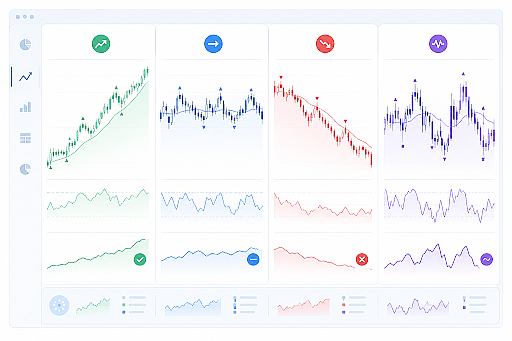

Many traders assume their strategy has stopped working when, in reality, the market environment has changed.
The market isn’t random. It’s constantly reacting to larger economic forces like interest rates, inflation, government policy, and the overall strength of the economy. These macro conditions influence which strategies thrive, which struggle, and where the best opportunities appear.
The goal isn’t to predict the economy. It’s to recognize the type of market you’re trading and adapt your playbook accordingly.
Lower Interest Rates Fuel Risk-Taking
When interest rates are low, money becomes cheaper to borrow. That typically means more liquidity, more leverage, and a greater appetite for risk across the market.
These environments often produce strong momentum trends. Growth stocks outperform, speculative names attract attention, and small-cap or OTC stocks can experience explosive moves. The post-COVID rally in 2021, with stocks like GameStop and AMC capturing global attention, was a prime example of what abundant liquidity can create.
For momentum traders, these are often ideal conditions.
Inflation Changes the Rules
Inflation doesn’t just move markets—it changes how they respond to news.
As inflation rises, investors begin anticipating higher interest rates, which generally put pressure on asset prices. Markets often become more defensive, making long momentum strategies less effective while creating more opportunities on the short side.
In 2022, inflation data and CPI releases became some of the most important market-moving events. Traders who understood how much attention the market was paying to those reports found opportunities, while those using the same strategies that worked during the previous bull market often struggled.
Elections Can Create Entirely New Opportunities
Presidential elections bring more than political change—they often reshape the trading landscape.
New administrations introduce different economic priorities, regulatory approaches, and policy decisions that can significantly affect market behavior. They also generate a steady stream of headlines, many of which become catalysts for major price movements.
Recent years have shown just how powerful those headlines can be. Trade policies, tariff announcements, and shifting political rhetoric have repeatedly caused significant moves across global markets. Regulatory changes also influence areas like mergers and acquisitions, determining whether those opportunities become more or less common.
The takeaway is simple: sometimes your strategy isn’t failing—the market has simply stopped rewarding that type of setup.
Strong Economies Create Momentum
Healthy economies tend to encourage optimism, investment, and growth.
During these periods, momentum breakouts often perform well. Companies are more likely to go public through IPOs, industries attract investor attention, and emerging themes generate continuous trading opportunities.
In recent years, artificial intelligence became one of those dominant themes, creating opportunities across large-cap leaders, smaller companies, and countless news-driven trades. When markets are embracing growth, traders who recognize those themes often have a significant advantage.
Weak Markets Create Different Opportunities
A weaker economy doesn’t mean opportunity disappears—it simply changes.
Periods of fear and uncertainty often produce sharp selloffs, panic-driven volatility, and extreme price swings. While momentum traders may struggle, mean reversion traders can find exceptional opportunities as stocks become temporarily oversold.
Weak markets also tend to produce more capital raises, stock offerings, and distressed-company headlines. IPO activity usually slows, but volatility itself becomes an opportunity for traders who know how to navigate it.
The key is recognizing that every market environment rewards different skills.
Adapt Your Playbook to the Market
The biggest mistake traders make is trying to force the same strategy into every market condition.
Professional traders build multiple playbooks because they understand that no single setup works all the time. As macro conditions shift, they rotate toward the strategies that fit the current environment while reducing exposure to those that don’t.
A strategy that performs exceptionally well during a bull market may struggle during periods of high inflation or economic uncertainty. That doesn’t necessarily mean the strategy is broken—it simply means the market has changed.
Study the Environment, Not Just the Charts
One of the best exercises any trader can do is review past performance alongside the broader market environment.
Ask yourself:
- Which strategies perform best during strong bull markets?
- Which setups excel during periods of volatility?
- When should you become more aggressive, and when should you scale back?
- Is it me or the market? Learn more HERE
Answering these questions helps build a trading process that’s flexible instead of rigid.
Final Thoughts
Markets constantly evolve, and successful traders evolve with them.
Rather than trying to predict every economic headline, focus on recognizing the environment you’re in. Whether it’s a low-rate bull market, an inflation-driven correction, an election year, or a period of economic weakness, each regime creates its own set of opportunities.
The traders who consistently perform well aren’t necessarily those with the best single strategy. They’re the ones who understand when to use each strategy—and when to step aside.
Learning to adapt may be one of the most valuable edges you can develop as a trader.
