

This topic comes from one of the best questions I’ve ever been asked.
Back in 2022, while doing advisory work with SMB Capital, many traders were struggling to adapt to a slower market environment after an extended period of strong momentum.
In meeting after meeting, I kept emphasizing the same thing:
go back to basics.
Stay selective.
Wait for your “easy money” setups.
Do your daily report cards.
Stick to weekly and monthly reviews.
Then a brand-new trader — without realizing how sharp his question was — asked:
“If the solution is always to return to best practices… why do traders ever drift away from them in the first place?”
It sounds simple. But it cuts straight to the core of why traders fall into boom–bust cycles.
Why We Drift From What Works
Every trader has experienced it.
You find a rhythm. You follow your process. You trade well. Results improve.
Then slowly — almost invisibly — things begin to slip.
You stop journaling consistently.
You take slightly worse setups.
You get a little less disciplined.
And before you know it, performance starts to decline.
This pattern isn’t unique to trading — it’s human nature.
As James Clear explains, outcomes are a lagging indicator of your habits, while your habits are a leading indicator of your future outcomes.
That idea explains a lot:
- Traders who outperform often later underperform
- People regain weight after dieting
- Companies overexpand, then overcorrect
Success often plants the seeds of future failure — because as results improve, discipline tends to fade.
The Boom–Bust Cycle Explained
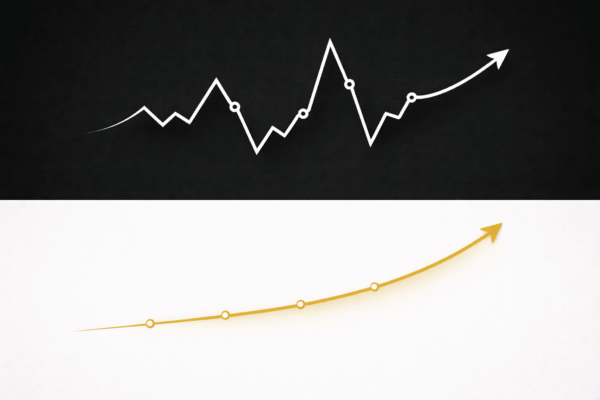
The boom–bust cycle in trading performance usually looks like this:
- Discipline phase – You follow your rules, stay selective, and execute well
- Performance phase – Results improve, confidence rises
- Drift phase – You loosen standards, take more trades, skip process
- Drawdown phase – Performance deteriorates
- Reset phase – You return to basics… and the cycle repeats
The key problem isn’t a lack of knowledge.
It’s a lack of consistency in applying what already works.
How to Break the Cycle
If the problem is inconsistency, the solution is building systems that hold up across all conditions — good markets, bad markets, high motivation, low motivation.
1. Build Minimum Sustainable Habits
You need a core set of practices that you can realistically stick to every single day, regardless of circumstances.
Ask yourself:
- What are the non-negotiables in my trading process?
- What can I do even on my worst, busiest, or most unmotivated days?
Examples might include:
- A simple daily report card
- A weekly trade review
- Reviewing a small number of charts or recordings
These habits should strike a balance:
- Simple enough that you won’t skip them
- Effective enough that they still move you forward
In many cases, removing bad habits is just as powerful as adding new ones. Eliminating one consistently harmful behavior can create more progress than adding multiple new “good” ones.
2. Lower Friction as Much as Possible
The easier it is to follow your process, the more likely you are to stick with it.
That means making your habits:
- Simple
- Fast
- Enjoyable
- Repeatable
For example:
- A report card that uses charts instead of long written notes
- A pre-defined checklist instead of making decisions from scratch
- Pre-planned routines that remove guesswork
The goal is to reduce the amount of thinking required to stay consistent.
The more automatic your habits become, the less likely you are to abandon them when things get difficult.
3. Accept That Cycles Will Still Exist
There will always be ups and downs.
You’ll have periods of high motivation and periods where everything feels like a grind.
The goal is not to eliminate volatility in your performance entirely — that’s unrealistic.
The goal is to reduce the amplitude of the swings.
When you maintain minimum standards during tough periods, you prevent small lapses from turning into major setbacks.
Consistency Over Intensity
Whether you’re applying this to trading, fitness, business, or anything else, the principle remains the same:
Consistency beats intensity over the long run.
It’s not about having perfect days.
It’s about maintaining a baseline that keeps you moving forward.
If you can identify the minimum set of habits that truly matter — and commit to them regardless of conditions — you give yourself a massive edge over time.
The Real Objective
Breaking the boom–bust cycle isn’t about finding new strategies or chasing better setups.
It’s about building a system that ensures you consistently execute the strategies you already know work.
Figure out your minimum sustainable best practices — the actions you can control and commit to across all environments — and anchor yourself to them.
Because in the end, long-term success in trading isn’t built on your best days.
It’s built on what you do every day. Check out this post if you want to read more about what the Trading Learning Curve really looks like!
