
If you’ve been following along through the previous lessons, there’s one idea I’ve been repeating over and over:
Edge is everything.
And because of that, it deserves to be examined from multiple angles — especially when it comes to your actual trading data.
In this lesson, we’re going to break down how to think about your performance metrics once you’ve started collecting trade data, and how to use that information to move closer to consistent profitability.
Start With the Big Picture
Before diving into individual metrics, you need to understand what you’re really trying to measure:
How does this strategy grow (or shrink) capital over time?
To answer that, you begin with the core return variables:
- Starting capital
- Ending capital
- Net P&L (after all costs)
- Percentage return
These numbers give you the macro view of performance. They allow you to see how a strategy would have compounded over time and whether it has any real long-term viability.
Don’t Ignore the Cost Side of Trading
A strategy doesn’t exist in a vacuum. Costs matter — often more than people think.
Key expenses include:
- Commissions
- Borrow or locate fees (for shorting strategies)
- Platform, data, or execution-related fees
Even a strategy that looks profitable on paper can break down once these are included.
A key rule of thumb:
Your gross edge must comfortably exceed your total costs.
If it doesn’t, the strategy isn’t viable — no matter how good it looks in isolation.
Understanding Your Activity
Next, you need to zoom into how the strategy behaves in action:
- Total number of trades
- Number of winning vs losing trades
This is where sample size becomes important.
A small dataset can easily mislead you. More data points give you:
- More confidence in results
- Better statistical reliability
- A clearer picture of hidden risks
As a general guideline, you want enough trades to avoid drawing conclusions from randomness — more is always better.
Breaking Down Performance
Once you have enough data, you can start analyzing the actual structure of performance:
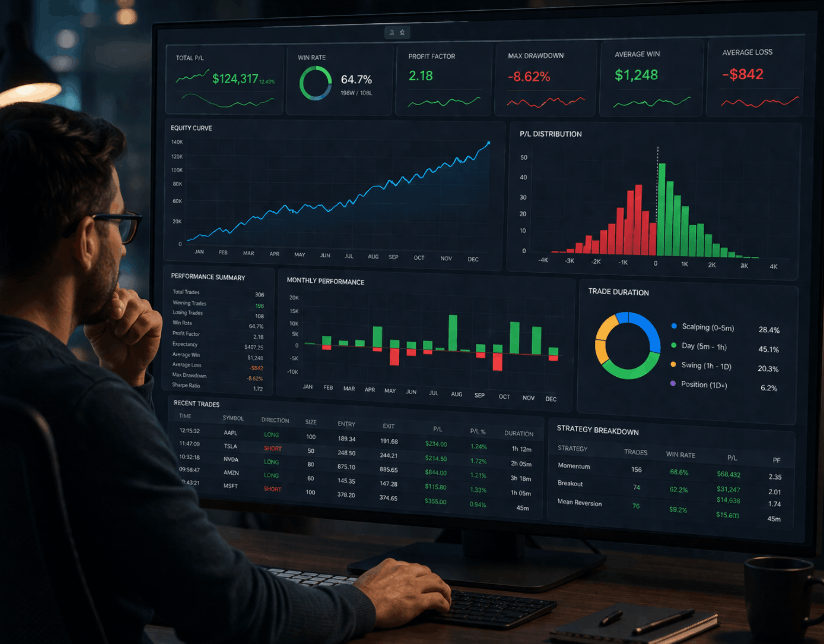
- Win rate
- Loss rate
- Average win size
- Average loss size
- Total profit from winners
- Total loss from losers
From here, you can derive two of the most important concepts in trading:
Expected Value
How much you make or lose per trade on average.
Profit Factor
How much you make versus how much you lose.
If your expected value is positive and your profit factor is above 1, the system has an edge in theory.
The higher these numbers, the stronger the strategy tends to be.
The Risk Side of the Equation
Good performance means nothing if the risk profile is unstable.
That’s why you also need to track:
- Maximum winning streak
- Maximum losing streak
- Biggest single win
- Biggest single loss
- Maximum drawdown (both absolute and percentage-based)
These metrics tell you how the strategy behaves during stress.
Because even a profitable system can fail in practice if:
- Drawdowns are too deep
- Losing streaks are psychologically unbearable
- A single trade can damage the account
Risk isn’t just mathematical — it’s behavioral.
If you can’t emotionally or financially survive the downside, the strategy is unusable, no matter how good the stats look.
Putting It All Together
Good analysis isn’t about isolating one metric.
It’s about understanding how everything interacts:
- Returns
- Costs
- Win/loss distribution
- Risk exposure
- Behavioral tolerance
From there, you can start improving the system intelligently.
Ask questions like:
- Is there a subset of setups where this performs better?
- Can filters improve edge?
- Are there conditions where performance breaks down?
- Can position sizing be adjusted based on quality?
And most importantly:
- Why does this edge exist in the first place?
Because once you understand why something works, you can often find more of it — or build variations of it.
Final Thoughts
At the end of the day, every trading system should aim for one thing:
Positive expectancy after all costs.
But getting there is rarely simple.
It requires:
- Careful data tracking
- Honest performance evaluation
- Ongoing refinement
- And disciplined risk control
The traders who succeed long-term aren’t the ones who find a perfect system.
They’re the ones who continuously measure, adjust, and improve the systems they already have. Don’t forget to also build out your Daily Report Card.
